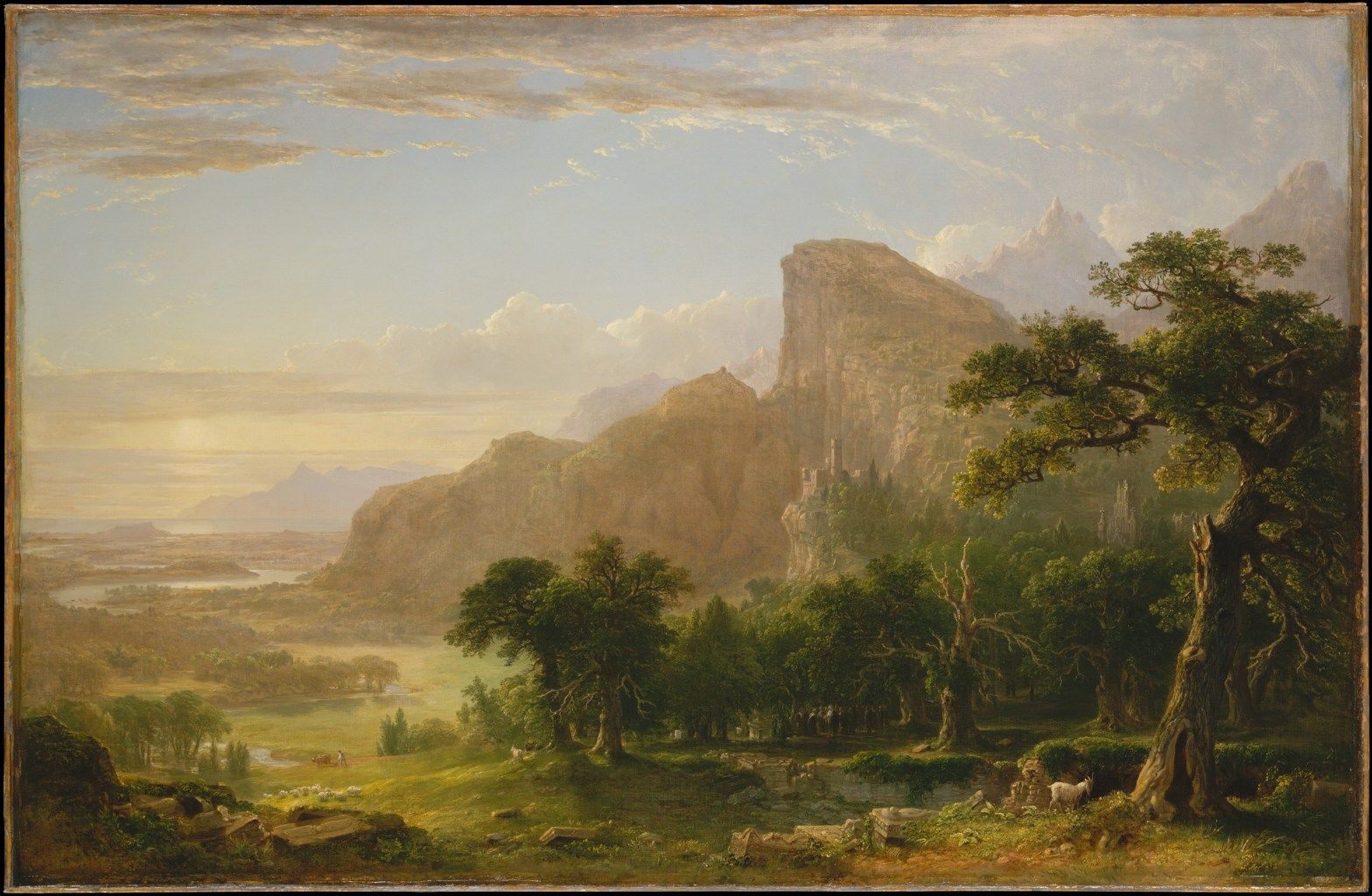
And Lord, dear cousin,’ said he, ‘doth not the pleasantness of this place carry in itself sufficient reward for any time lost in it? Do you not see how all things conspire together to make this country a heavenly dwelling? Do not these stately trees seem to maintain their flourishing old age with the only happiness of their seat, being clothed with a continual spring, because no beauty here should ever fade?’
-Sir Phillip Sydney, The Countess of Pembroke’s Arcadia1
We all have our favorite imaginary places. Whether we prefer fantastic domains like Arrakis and Narnia or more realistic haunts like Baker Street and Yoknapatawpha County, visiting a beloved literary neighborhood can prove a much-needed break. Nor is this merely a recent phenomenon. For four hundred years, a trip to Sir Phillip Sidney’s idealized kingdom of Arcadia has been the equivalent for many a delighted reader of an extended pleasure cruise.
With a plot that sprawls over eight hundred pages, written in a dense rhetorical style, The Arcadia may not be everyone’s cup of tea. But those willing to take the time to explore this fascinating sixteenth-century gem will find themselves well-rewarded.
When the mysterious prince Musidorus washes up on a beach in Laconia, he is befriended by the shepherds Claius and Strephon from the nearby kingdom of Arcadia. The prince beseeches his benefactors to help him rescue his friend and cousin Pyrocles. But as they set out into the bay, they see pirates approach and take the young man who is the object of their search captive—the disconsolate Musidorus journeys with the shepherds to their marvelous homeland of Arcadia. Soon, however, by the curious working of fate, he and Pyrocles are reunited. Together, they embark on a series of remarkable exploits.
But before we venture farther into the territory of plot and themes, perhaps we should pause to consider precisely what kind of a book we have set out to discuss. We might call the Arcadia a historical novel. Its purported setting is classical Greece and the surrounding territories. However, it’s an oddly anachronistic tale whose ancient Hellenic characters wear elaborate suits of armor and adhere to the chivalric traditions of later Renaissance Europe. It is evidently far from the author’s mind to accurately dramatize the historical realities of an earlier epoch.
Moreover, while it’s written in prose, the book is punctuated with long sections of verse when the Arcadian shepherds compete in pastoral singing contests. Some of these songs comment on the action. In contrast, others take us into new territory, so we are left with the impression that all of the complex machinery of plot may be no more than an elaborate setting for the luster of these rich poetic jewels.
Finally, while we may call the Arcadia a novel, that term was not applied to prose works in Sidney’s day. When it did come into vogue, the “novel” had associations with the trend toward realistic fiction. Perhaps we may understand the nature of the work better if we return to the ‘outworn’ term and call it a romance in the sense that the term was used in the English Renaissance. Its antecedents would include works like Heliodorus Ethiopika and Boiardo’s Orlando Innamorata. In reading it then, we find ourselves in an idealized fairy tale landscape of bucolic shepherds, courtly knights, and chivalric tournaments.
The Arcadia originally circulated among Sidney’s friends in a shorter version referred to by scholarly convention as The Old Arcadia. Throughout the latter portion of his life, Sidney worked tirelessly to revise the work, expanding and adding to it substantially. Sadly, he did not live to complete amendments, and the current text includes a brief narrative bridge connecting the new material with the ending of the Old Arcadia. Sidney’s sister oversaw this editorial process so that the book as it was published is generally referred to as The Countess of Pembroke’s Arcadia.
Some of Arcadia’s themes are blatantly political. One central element of the plot is that Arcadia’s king, fearing a mysterious prophecy, has withdrawn from his palace and responsibilities, effectively abdicating the governance of his kingdom. Sidney, an aristocrat’s aristocrat is ever showing the dire effects that occur when rulers loose their grip on the reigns of power.
The political lessons that would have been self-evident to Sidney’s fellow nobles ring hollow in today’s world. But his other main theme humanizes and deepens Arcadia. During their adventures, both Musidorus and Pyrocles fall in love, and the writer explores this universal human experience with great sympathy, insight, and humor.
The callow Musidorus at first scoffs at his cousin, who has fallen in love. Later, he too is swept away by this gentle passion. Sydney explores love as an irresistible force of nature and as something that enobles and enriches those touched by it. As Claius once remarks, “Hath not the only love of her made us, being silly ignorant shepherds, raise up our thoughts above the ordinary level of the world?”2
We have touched on the unusual form of the book as a blend of prose and poetry. However, it may be its prose style that modern readers find most difficult. We are the inheritors of the modernist legacy and the minimalist aesthetic popularized by writers like Hemingway that shuns artificiality and artifice.
The Arcadia, by contrast, presents us with a heady tour de force of rhetoric that Sidney’s contemporaries would have loved. The writer sprinkles his text with pithy aphorisms and sententiae. Throughout the tale, characters enter into formal arguments with one another, and many of these verbal jousts prove as compelling as the literal ones. We must set aside our preconceptions and learn how to read and appreciate the work as we go on.
This education of taste will help us gain a fuller appreciation of the work. The lush maximalist style forms a critical element in the novel’s other central theme: that of beauty.
Sidney sounds this note from the outset of his story. As Claius and Strephon guide the stunned Musidorus into Arcadia, he notices an immediate difference between this domain and the one he has just left. “There were hills which garnished their proud heights with stately trees; humble valleys whose base estate seemed comforted with refreshings of silver rivers; meadow enameled with all sorts of eye-pleasing flowers; here a shepherd’s boy piping as though he should never grow old; there a young shepherdess knitting and withal singing.”3
Later, as Pyrocles persuades his cousin to stay in Arcadia, he invokes the country’s never-fading beauty in the epigraph at the head of this article. Arcadia, then, is an idealized realm of eternal beauty. And a story set there must be told in beautiful language, consciously artificial and artful, employing every rhetorical strategy known since classical times.
The love of and creation of beauty was a driving force throughout Sidney’s life. His biographer Grenville Fulke recounts that even on his deathbed, the poet remarked that he believed God must be good because of the beauty of the world he made. “The Lord Himself is an infinite spirit, and his providence reacheth unto all things. He is a most good spirit; for otherwise how should the world continue in the beauty it hath.” 4
The Arcadia remained popular long after its publication. A possibly apocryphal story credits King Charles I with quoting it on the scaffold before his execution. One of the characters undoubtedly lent her name to the titular Pamela in the novel of that name penned by Samuel Richardson in the eighteenth century. We might even find Arcadian echoes in the contrasting characters of the Dashwood sisters in Sense and Sensibility. Today, Arcadia has largely been taken over by the scholars. But for those who hunger for eternal beauty, a trip to Sidneyland might just be the ticket.
If you liked this article, check out my published work here.
Notes
- Sidney, Sir Philip, The Countess of Pembroke’s Arcadia, Penguin Books Edition, 1977, p.112
- Sidney, p.63
- Sidney, p.69
- Connell, Dorothy, Sir Philip Sidney, The Maker’s Mind, Clarendon Press, 1977, p.3
Eternal Beauty, Copyright 2025, Jonathan Golding
Artwork: Landscape Scene from Thanatopsis, Painting by Asher Brown Durand, Public Domain
 Worlds Imagined