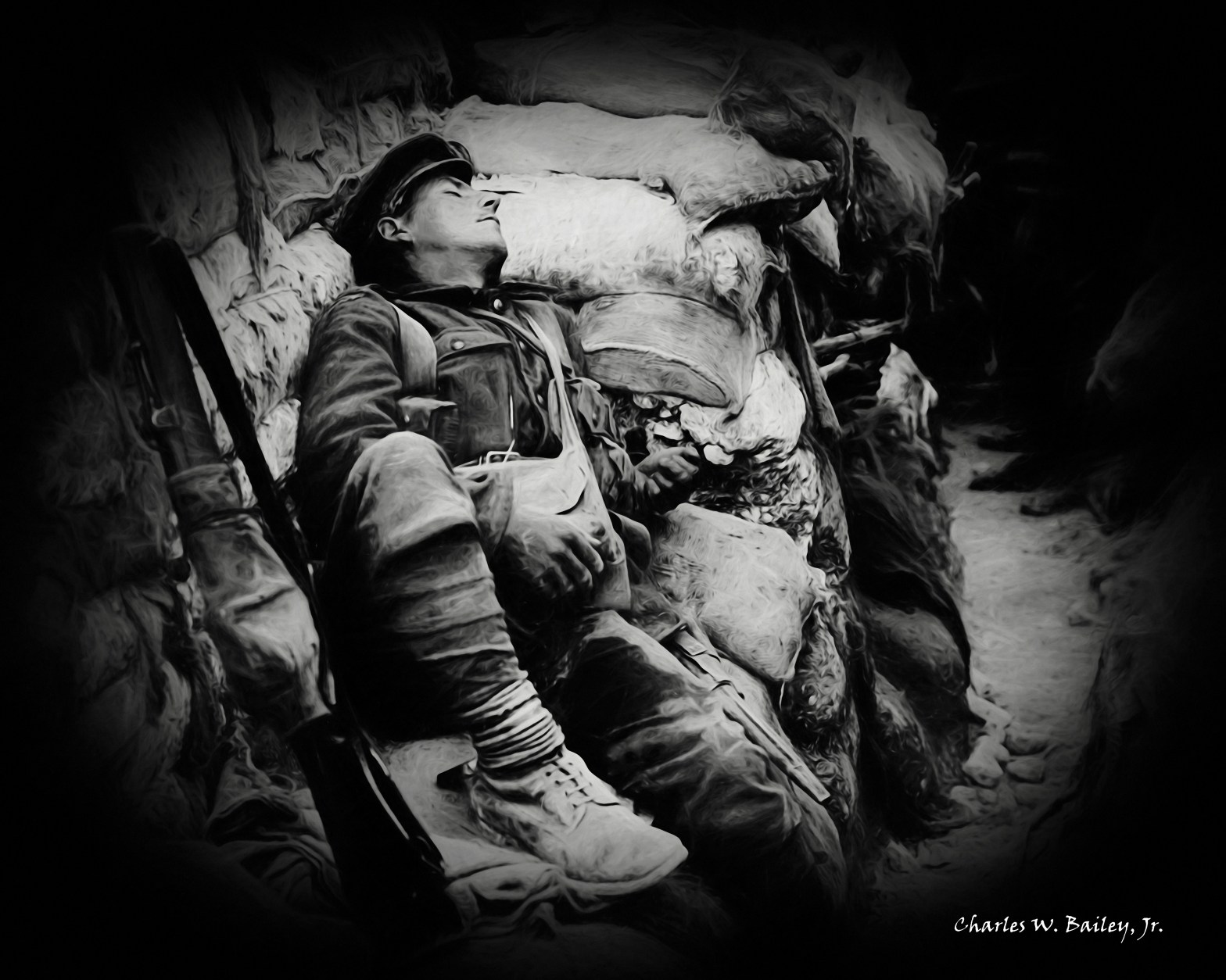
We must never turn away from horror. One of the vital responsibilities of the artist is to bear witness to atrocities, disasters, and tragedies – to shine a light into the dark corners of human experience. But sometimes the way in which an artist approaches this great task is as important as the content of his work.
When we think of poets of the First World War, Wilfred Owen, Siegfried Sassoon, or John MacRay might come to mind. These writers penned their verses using traditional forms in an attempt to convey the pathos of that brutal conflict. And while their works are both beautiful and tragic, they are often hampered by their conventional style. There is a sense that the medium is at odds with the message as they struggle to capture the horrors of modern mechanized warfare. But when another author of that generation came to detail his experiences in the trenches of the Great War, he cast his poetic narrative in a radical, Modernist style reminiscent of T.S Eliot’s The Wasteland.
Eliot himself praised David Jones’ In Parenthesis as a great poem, and other literary luminaries such as W.B Yeats and W.H. Auden were quick to join in the acclaim. But today he remains a relatively obscure figure in literary history. As Thomas Dilworth puts it, “Few poets have been so highly praised, especially by fellow poets. And few poets who have been so highly praised have been so neglected.”1
Like Erich Maria Remarque’s All Quiet on the Western Front, Jones’ book fictionalizes his experiences in the war. It begins at his unit’s regimental headquarters and covers his company’s journey to France and their nightmarish time in the trenches of the Somme. The narrative culminates in a tragic and confused raid on the Mametz Wood in which most of the unit is killed and the protagonist himself is wounded. But where Remarque’s text takes a straightforward novelistic approach, In Parenthesis combines prose, free verse, scraps of dialogue, and popular songs to create an elliptical, gritty, and impressionistic account that places the reader in the heart of events.
While “modernist” was a designation that Jones sometimes rejected for his work, it is the term that seems to fit best. “Modernism should be taken to refer to writing that expresses a degree of dissatisfaction with prevalent inherited literary conventions and attempts to extend or challenge them.”2 And many modernist writers, such as Eliot and Yeat,s felt strongly that their project was not to tear down the old, but to make something new that drew on the rich literary tradition they had inherited. In Parenthesis demonstrates both these tendencies.
Jones casts himself in the drama as Private John Ball, but the narrative shifts fluidly from third person to second person and from past tense to present in a radical way that leaves the reader as disoriented as the protagonist. This strategy viscerally draws us into events in a manner no traditional verse can match. When Ball’s company at last comes to the rat-infested, mud-stinking trenches, Jones writes, “You step down between inward inclining, heavily bulged, walls of earth; you feel the lateral slats firm foothold. Squeaking bead-eyed hastening, many footed hurrying, accompanying each going forward.”3
But at times, even amid the horrors of their situation, Jones registers evanescent moments of beauty. When the moon shines out over the battlefield, he writes, “Cloud shielded her bright disc-rising yet her veiled influence illumined the texture of that place, her glistening on the saturated fields; bat-night-gloom intersilvered where she shone on the mist drift.”4
The fragmentary interpolated style flies in the face of the conventions of narrative verse and prose fiction. We don’t seem to be reading a novel or a poem, but a work that occupies a liminal space between the two. It is as if the trauma of the war has blasted a crater in all literary conventions, leaving us in a bleak no man’s land.
But Jones’ intent is not to break with the past. Rather, everywhere we look, we find echoes of historical and mythological events. The epigraphs that head each section of the book are drawn from a medieval Welsh poem, Y Goddodin, that tells of a king who foolishly sent his soldiers into a doomed battle that slaughtered the better part of his army. One reads, “Men went to Catraeth as day dawned: their fears disturbed their peace. Men went to Catraeth…death’s sure meeting place, the goal of their marching.”5
These and other allusions scattered throughout the densely layered text undercut any sense of triumph over the outcome of the First World War. They also raise the events of In Parenthesis into a more universal context. John Ball and his unit become all soldiers throughout history, conscripted, manipulated by propaganda, and forced to die on lonely battlefields in futile wars.
But war is not Jones’s only focus. As he would write later in The Dying Gaul, “The technocracy in which we live is of its nature concerned with the purely utile, with what functions.” 6 Charles Andrews elaborates on this theme in Jones’ work. “This obsession with functionality makes humans into automata. War is an especially destructive feature of modernity because the utile overwhelms all other virtues. Troop movements, battle strategies, and the management of equipment-all matters of utility-are essential to military existence.”7
In Parenthesis was not published until 1937. By then, fascism was casting long shadows over Europe, and Jones had had time to process his trauma in the trenches of the Somme. The war came to signify not only itself, but all mass movements in which the participants are dehumanized and stripped of their dignity. It became a paradigm and metaphor for such manipulations, and the work is a fierce critique of this sinister tendency in which human beings are merely valued for their utility rather than their intrinsic worth.
David Jones is a much-neglected writer who deserves a wider audience than he has gained in the years since the modernist project fell out of fashion. He left us a searing account of what it was like to be a common soldier caught up in the events of the Great War. But his work transforms and even transubstantiates those experiences into high art. In Parenthesis delivers a powerful message about the value of the individual human person faced with dehumanizing forces that remains as relevant today as when its author penned it.
If you liked this article, check out my published work here.
Notes
- Dilworth, Thomas, The Shape of Meaning in the Poetry of David Jones, University of Toronto Press, p.4
- Gasiorek, Andrzej, A History of Modernist Literature, Wiley Blackwell Publishing, p.3
- Jones, David, In Parenthesis, New York Review Books, p.45
- Jones, p.27
- Jones, p.133
- Jones, David, The Dying Gaul and Other Writings, Ed. Harmon Grisewood, Faber, p.44
- Andrews, Charles, War Trauma and Religious Cityscape in David Jones’s “In Parenthesis” The Journal of the Midwest Modern Language Association, Vol. 40, No. 1 (Spring, 2007), p.88
All Quiet on the Modernist Front: David Jones’ In Parenthesis, Copyright Jonathan Golding, 2026
Artwork, The Sleeping Soldier, Charles W. Bailey, jr, Free Use Attribution
 Worlds Imagined